Showing posts with label Kafka's letter to his father. Show all posts

Tuesday, 15 December 2015

KAFKA’S FATHER REPLIES: You have no capacity for life.

In the Letter to His Father, Kafka imagines his father’s reply:

You have in mind to live off me entirely. I admit that we are in a fight, but there are two kinds of fights – chivalrous combat, in which two independent fighters match strengths, in which each man remains independent, loses for himself, wins for himself. Then there is the fight fought by vermin, which not only stings but also sucks blood to sustain itself. That is the fight of the professional soldier – you. You have no capacity for life. To live comfortably and without worry and without blaming yourself, you prove that I have taken all capacity to live from you and put it into my own pocket. Why would you worry about your lack of ability when it is my fault and responsibility? You lie down idly and allow me to drag you through life in body and mind.

Here is an example: Recently you wanted to marry. At the same time you did not want to marry (as you admit in your letter). To avoid any stress, you turned to me for help by forbidding you to marry and arguing that it would bring shame on my name. But I did no such thing. First of all, here as in other cases, I did not wish to get in the way of your happiness; secondly I would never want to hear such an accusation from my child. But was my self-discipline and the forbearance with which I gave you the option to marry of any avail to me? No, my objections would not have prevented your marriage. On the contrary, they would have been an added stimulus for you to marry the girl. Thus your attempt to flee from me (as you put it) would have been complete. Yet my permission to marry did not keep you from bringing accusations against me. You prove that it was in any case my fault that you did not get married…although it only proved that all my reproaches were justified. Indeed I did not mention one reproach that was especially fitting: accusing you of being untruthful, subservient, and parasitic. Indeed your letter is parasitic, if I am not mistaken.

I reply first of all: This interjection, which could also be turned against you, is mine rather than yours.  Your distrust of others is not as great as the distrust in myself, which you nourished in me. To a certain extent the interjection is justified, and indeed adds new material to characterize our relationship – I won’t deny it.  The proofs I offered in my letter cannot fit as neatly in real life – living one’s life requires more patience. But the correction which follows from this interjection, a correction which I cannot and will not execute in its details, does succeed in approximating the truth in my opinion, and may calm things between us and make our life and death easier.
Franz

And that’s the end of Kafka’s letter. Use the search function to check my older blogs for other passages from Kafka’s Letter to His Father:
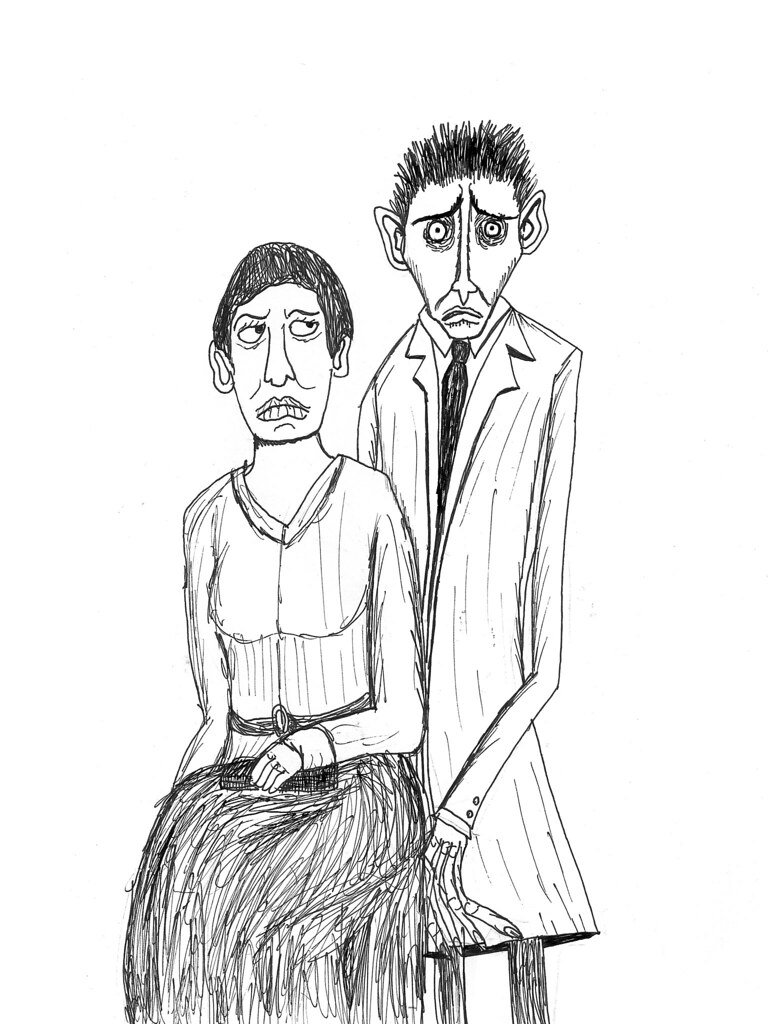
(Image from www.kafkaestblog.files)

Wednesday, 9 December 2015

From #Kafka’s Letter to his Father: Fear of marriage.


There is a belief that fear of marriage has its origin in fear that one day your offspring will pay you back for the sins you committed against your own parents. That has no great relevance to my case, I believe, because my bad conscience originated in you and is unique in every respect. Indeed the sense that it is unique is part of my torment. I can’t imagine that it could be duplicated. I must say, however, that I myself could not bear such a silent, dull, dry, decadent son [as I am]. If I had no other option, I would flee, that is, emigrate, as you wanted to do on account of my marriage plans.

But the most important obstacle to a marriage is the indelible conviction that maintaining and even more so, heading a family requires all the qualities I recognized in you, that combination of good and evil which is organically united in you:  inner strength and outward derisiveness, health as well as a certain grandiosity, the gift of oratory as well as reserve, confidence in oneself and dissatisfaction with everyone else, a sense of universal superiority and a tyrannical spirit, knowledge of people and distrust against most of them; in addition the assets that have no disadvantages such as industry, stamina, ready wit, courage. Of all these qualities I had comparatively few or hardly any. I this state I did not want to take the risk of marriage, when I saw that even you had to fight hard in your marriage and even you failed with respect to your children.

But naturally I did not explicitly phrase the problem like that in my mind and did not expressly respond to it, or the usual thought process would have taken over and proffered me examples of other men, different from you (my uncle Richard to mention one man close at hand and very different). I would have thought of the men who married nevertheless and at least did not collapse under the burden, which is already a great achievement and would have amply satisfied me. But I did not approach marriage in this questioning manner. I experienced your marriage from childhood on…and your example persuasively proved that I was incapable of marriage.
How then can I go ahead and marry without going mad! – And that is the conclusion of my life with you up to now, and that is the outlook for the future it carries within it.

(Source: Letter to my Father, text on www.kafka.org; my translation)

Monday, 16 November 2015

KAFKA ON THE EXEMPLARY MARRIAGE: LOYALTY, CHILDREN, AND MUTUAL SUPPORT.
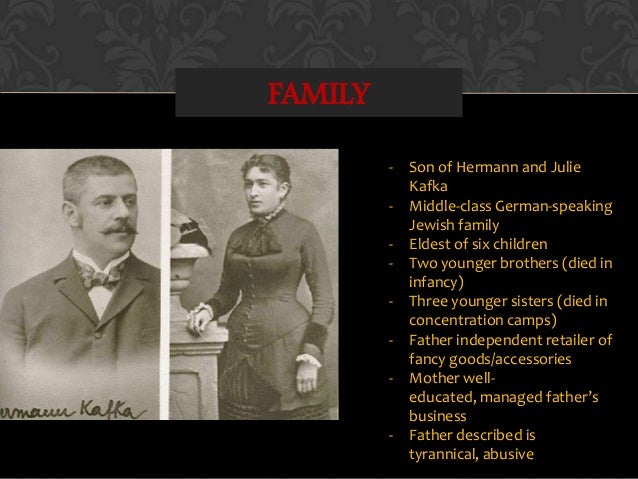
Kafka's parents


Marriage is certainly the clearest proof of self-liberation and independence [from one’s family]. It would give me a family of my own – the highest of all achievements in my opinion, and indeed your highest achievement. It would make me your equal. All the old and new embarrassments and your tyranny would be no more than past history then. That would be like a fairy tale, and that is what makes it questionable. It is too great an achievement to be attainable. I would be like a captive who had intentions not only to flee, which might be attainable, but who intended at the same time to remodel his prison and make it into a pleasure dome. But when he flees he cannot remodel it, and if he wants to remodel it, he cannot flee.

If I want to free myself from my particularly unhappy relationship with you and become independent, I must achieve something that has, if possible, nothing whatsoever to do with you. Marriage is the greatest achievement and offers an honourable way to become independent, but it is also most closely associated with you. To escape in this manner has an element of madness about it, and every attempt therefore carries a penalty…

The way things are between us blocks my way to marriage, because it is your most personal area of engagement. Sometimes I imagine a map of the world laid out before me, and you lying stretched across it. Then I have the feeling that the only areas feasible for me to inhabit are those you do not cover, those that are outside your reach. That is, roughly, my idea of your greatness. There are not many or very comfortable areas left, and marriage is among the areas [covered by you]…


Your marriage offered me in many ways an exemplary model, exemplary in loyalty, mutual support, and number of children. Even after the children grew up and increasingly disturbed the peace, your marriage remained untouched in its essence.  It may have been exactly this example that developed in me a high opinion of marriage. There were other reasons that made me powerless to realize my own desire to marry. They had to do with your relationship to your children, and that’s what this whole letter is about. 

(Source: Letter to my Father, text on www.kafka.org; my translation. Image: slidesharecdn)

Monday, 9 November 2015

KAFKA’S LETTER TO HIS FATHER: CONDOMS AND MARRIAGE.
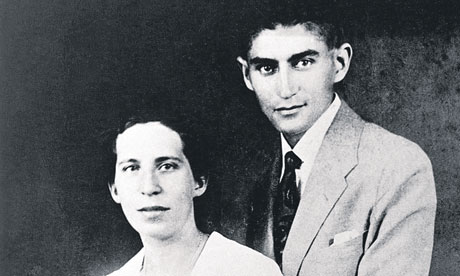
Kafka's fiancee Julie Wohryzek

More from Kafka's Letter to His Father:

When Kafka first talked to his father about sex, he advised him to use a condom.I can’t remember how old I was at the time, certainly not older than sixteen… It was the first direct lesson in life which I got from you.

But Kafka found his father’s advice morally offensive and was unable to believe that his father had ever followed his own advice. He was pure, above such things. This idea crystallized in my mind perhaps because marriage seemed shameless to me, and I was therefore unable to apply what I had heard about marriage in general to my parents in particular.

For Kafka this incident was proof that neither he nor his father were at fault for their alienation. It was a case of A speaking openly to B, giving him advice hat is not nice but quite usual in the city and perhaps preventing health problems. This advice is not exactly edifying for B, but there is not reason why he could not overcome this disadvantage over the years. In any case he need not follow the advice, the advice by itself is not reason why the whole future world should collapse. And yet something like this happened, but only because you are A and I am B.

Kafka connected this encounter with another one which happened twenty years later, a conversation after he had informed his father that he was going to marry Julie Wohryzek. In a letter to Max Brod he describes her as Jewish and non-Jewish, German and non-German, loves the cinema, operetta, and comedies, loves make-up and veils, has an unusual and continuous supply of the sassiest jargon, is on the whole ignorant.
Kafka’s father was totally against the marriage. He said: She probably put on a special blouse – the Jewish girls of Prague usually know how to go about that –and so you naturally decided to marry her as soon as possible, in a week, tomorrow, today. I don’t understand you. You are an adult. You are urbane, and you don’t know better than to marry just anybody? Is there no possibility to get out of it? If you are afraid, I’ll come with you.

He was clearly contemptuous of the man who seemed to him just as inexperienced and foolish as twenty years ago when they had the conversation about the use of condoms.

(Source: Letter to my Father, text on www.kafka.org; my translation)

Thursday, 29 October 2015

WHY #KAFKA DID NOT GET MARRIED.

More from Kafka's Letter to His Father:
Of course you could say quite a bit about my attempts to marry, and you did. You were unable to show a great deal of respect for my decisions since I broke off my engagement with F[elice Bauer] twice and twice renewed it again, when I dragged you and mother needlessly to my engagement party in Berlin, etc. All that is true, and how did it come about?

The basic idea behind my attempts to marry was sound: to form a household, to become independent, an idea which is agreeable to you but in reality works like the game children play, in which one holds on to the other and even presses his hand, calling out: "Go then, go already, what’s keeping you?" In our case there is a complicating factor: you truly meant the exhortation “Go already!” At the same time and without being aware of it, you held me fast or rather you held me down because of who you are.

Kafka's father wrongly thought he had acted impulsively in taking up with Dora Dymant.You thought I could decide to marry in one fell swoop, just because of a blouse [Dora was wearing] – I who was so anxious, hesitant, and suspicious. If he had married either woman, it would have been the result of a rational decision. 

Neither of the girls disappointed me, although I disappointed both. My judgment concerning them is exactly the same today as it was then when I wanted to marry them. Why, then, did I not marry? There were several roadblocks, as is always the case, but life consists in surmounting those roadblocks.  The main roadblock, however, had nothing to do with the women specifically. Apparently it had to do with my mind, my inability to face marriage, which manifests itself in this form: from the moment I decide to get married, I can’t sleep. My head is glowing hot day and night. I can’t stand to live like that. I am undecided and in despair.  This is not caused by actual worries. Although worries are a constituent part of my melancholy and pedantic mind, they are not the decisive element. Yet, like worms in a corpse, they complete the destructive work. The decisive element is something else: the general pressure caused by anxiety, weakness, and lack of self-respect.

(Source: Letter to my Father, text on www.kafka.org; my translation)


Wednesday, 7 October 2015

KAFKA AND THE FACTS OF LIFE.
James Hawes on Kafka

Continuing with Kafa’s Letter to His Father:
Getting married, establishing a family, accepting all children that happen to be conceived, to support them in this uncertain world and give them even a little guidance – I am convinced that is the utmost a human being can achieve. It is no counter argument to say that many people appear to achieve those things with ease, for first of all only few people achieve it in truth, and secondly those few do not actively seek that result. Rather it happens to them. It may not be the ultimate, but it is nevertheless a great and honourable achievement (especially because action and happenstance cannot be strictly separated). And in the end the point is not to reach the ultimate goal, but to approach it, yet go a respectable distance. It is not necessary to soar to the centre of the sun, as long as one manages to crawl to a clean little spot on earth, which is reached by the rays of the sun occasionally and where one can find a little warmth. How was I prepared for that step? As poorly as can be.

I remember an evening walk with you and mother. We were at the Josefsplatz near what is now the Länderbank, and I started to talk of those “interesting things” [i.e. sex] in a foolish, bragging, superior, proud, cool (feigned), cold (in truth) manner. I stuttered the way I often did in your presence, reproached you for leaving me unprepared, so that my classmates had to take care of me. I came close to being in great danger (here I lied shamelessly, as was my habit in order to appear daring). In fact because of my timidity I had no clear idea of the “great dangers”, knew only the usual sins city boys commit in bed, yet I indicated in the end, that luckily I knew everything by then, needed no advice, and everything was alright. But I had started on this topic primarily because it gave me pleasure at least to talk of the subject, also out of curiosity, and finally to avenge somehow whatever you had done to me. You simply accepted my words, as was your way. You said only that you could advise me on how I might engage in these things without risk. Perhaps that was the kind of reply I was fishing for. It suited the lasciviousness of a child fed on meat and all good things, physically inactive, and forever focused on himself. Yet my sense of decency was so hurt, or at least I thought it had to be hurt, that against my own inclination I could no longer speak with you about that topic and arrogantly or insolently broke off the conversation.
(Source: Letter to my Father, text on www.kafka.org; my translation)

Thursday, 1 October 2015

KAFKA AND MARRIAGE. Frailty, lack of self-confidence, and guilt feelings.
Image:CharlesPieperPuppets

I had almost no sense of the meaning and possibility of marriage for me…As a child I developed very slowly. These things were too external, too far removed from me. Occasionally there was a need to think of marriage but there was no indication that I was up for a continual, decisive, not to say, most bitter test. In reality my attempts to marry became the greatest and most hopeful attempt to escape you, and my failure was correspondingly great.  Since everything in that area is a failure, I fear I will not succeed in making you understand the significance of my attempts at marriage, and yet the success of this whole letter to you depends on it, for on the one hand all positive strength available to me was concentrated in those attempts, on the other hand all negative strengths accumulated in them too, and with a passion – all the results of your education, which I have described, that is: frailty, lack of self-confidence, and guilt feelings. They formed a kind of barrier between myself and marriage.  It is difficult moreover to offer an explanation because I have spent so many days and nights digging through and thinking about this subject that I am momentarily disoriented. The only element that makes my explanation easier is your complete misinterpretation of the matter, at least in my opinion. It does not seem to be difficult to introduce at least a small correction in this complete misinterpretation of yours.

First of all, you place my failure to marry among my other failures. I wouldn’t object to that, as long as you accept the explanation for my failures which I have offered.  My failure to marry is part of that chain, but you underestimate the significance of this matter to such an extent that when we speak of it, we actually speak of different things. I dare say nothing ever happened to you in your whole life which had such significance for you as my attempts to marry had for me…


(Source: Letter to my Father, text on www.kafka.org; my translation)

Friday, 28 August 2015

KAFKA AND HIS FATHER'S JUDAISM. Small mementos of a bygone time.

Kafka continues his letter to his father:
            Later, however, I came to look at Judaism differently and understood why you might believe I had maliciously betrayed you in that respect. You really brought a certain amount of Judaism from your small ghetto-like village community. It wasn’t much and lost a little more in the city and during your military service, but the youthful impressions and memories were enough for a kind of Jewish life style, especially since you didn’t need a great deal of help in that respect. You were made of solid stuff and could not be shaken by religious considerations if they weren’t mixed with social considerations. On the whole the faith that guided your life consisted in a belief in the absolute correctness of the opinions of a certain Jewish social class, and actually also in a belief in yourself, since those opinions were part of your own nature. There was enough Judaism in your nature, but too little to be handed on to a child. It seeped away and dried up as you handed it on. In a way those youthful impressions couldn’t be handed on. Either that, or your terrifying personality prevented it. It was impossible to impress on a child full of anxiety and therefore too closely observant that those few empty rites you practiced in the name of Judaism had any higher meaning, when you practiced them with an apathy corresponding to their emptiness. They were meaningful to you as small mementos of a bygone time and for that reason you wanted to hand them on to me, but you could not do it without urging and threatening me, since they had no intrinsic value for you. On one hand it was an undertaking that could not succeed, on the other hand you did not recognize your weak position in this matter and therefore were very angry with me on account of my apparent obstinacy… If your Judaism had been stronger, your example would have been more cogent.
(Source: Letter to my Father, text on www.kafka.org; my translation)

Sunday, 14 June 2015

UNDER THE CURSE OF MY FATHER’S TRAINING. MORE FROM KAFKA’S LETTER TO HIS FATHER.

My dislike for the family business – your creation – pained you, and you sweetened it with the statement that I had no business sense, that I had more exalted ideas in my head, and so forth. My mother was of course pleased with that explanation, which you forced on yourself, and I too in my vanity and need was influenced by your statement. But if “more exalted” ideas had been the only or the main thing that turned me off business (which I now – and only now—truly and actively hate), they should have manifested themselves in a different way than allowing me to glide through high school and legal studies quietly and anxiously, until I finally landed at an office desk.

If I wanted to flee from you, I had to flee from my family as well, even from my mother. I could always find protection with her, but only in a way related to you. She loved you too much and was too loyally devoted to you to be for any length of time an independent intellectual power in a child’s battle….Over the years my mother became even more closely tied to you. She preserved her independence only in the smallest compass, nicely and gently without hurting your innermost feelings. Yet, as the years passed by, she adopted your opinions and your verdicts about your children more fully and blindly, accepted them emotionally more than intellectually, especially in the difficult case of [Kafka’s sister] Ottla. Of course one must always remember that Mother’s position in our family was exhausting. She laboured in the store and in the household, she was a co-sufferer when anyone in the family was sick and suffered twice as much, but all that was exceeded by what she suffered being squeezed between us and you…

Elli Kafka

Elli is the only example of succeeding almost completely in breaking away from your circle. I would have expected it least of all from her in the early years. She was such a gawky, weary, timid, sullen, guilt-ridden, overly submissive, spiteful, idle, close-fisted child with a sweet tooth. I could hardly stand looking at her or talking to her. She reminded me too much of myself. We were so similar, being under the curse of your training. Especially her meanness disgusted me because that vice was even greater in me if that is possible. Meanness is the surest sign of deep unhappiness. I was so uncertain in all things, that I felt I owned only what I held in my hands or in my mouth or what was on its way there, and that is what she particularly liked to snatch away, even though we were in a similar situation. But all that changed when she left home as a young woman – young, that is important—when she married, had children, and became cheerful, carefree, courageous, liberal, unselfish, and full of hope.
(Source: Letter to my Father, text on www.kafka.org; my translation)

Thursday, 11 June 2015

KAFKA AND THE FAMILY BUSINESS. MORE FROM HIS LETTER TO MY FATHER.


As long as our business was a street-level store, it should have been interesting for me, especially in my childhood. It was so lively when it was lit up at night. I could see and hear a great deal, was able to help here and there, to excel, but most of all, to admire your great business talents – the way you sold things, treated people, joked with them, were indefatigable, made instant decisions in doubtful situations, etc.

It was a spectacle worth watching when you wrapped up goods or opened a carton. All in all, it wasn’t a bad teaching experience for a child. But because you scared me in everything, and I identified the business with you, I was no longer comfortable in the store. Matters that seemed normal to me at first tormented and embarrassed me, especially your treatment of the personnel. I don’t know whether it was like that in most businesses (in the Assicurazioni Generali, for example, the treatment of the staff was quite similar in my time; when I resigned, I gave the director an explanation which wasn’t quite truthful, but not altogether a lie. I told him that I could not stand the scolding, which by the way was not directed against me personally; I was too painfully sensitive to begin with), but other businesses did not concern me in my childhood.

I heard and saw you shouting in the store in a way that was unparalleled in the whole world (at least that’s what I thought at the time). And I witnessed not only your rants, but also your tyranny in other matters. For example if there were goods you did not want to have confused with others, you shoved them off the counter in one sweep, and your employee had to pick them up from the floor. The only excuse for your behaviour was the impulsiveness of your anger. Also, there was the phrase you constantly used about an employee who suffered from pleurisy: “That sick dog -- let him bite the dust!” You called your employees “paid enemies”, as they were indeed, but before they turned out like that, you were the “paying enemy”. In your store I also learned that you could be unjust. I would not have noticed it in my own case because I had amassed too much guilt, and always justified you. I corrected my youthful opinion a little but not radically, thinking there were people in your store, who were not part of our family, who worked there and had to live in constant fear of you. Of course that was an exaggeration because I assumed that you instilled the same fear in those people as you did in me. If that had been the case, their lives would have been unbearable indeed. But they were adults in perfect control of their emotions. They shrugged off your rants without effort, and in the end that kind of behaviour harmed you more than them. As for me, it made the store unbearable because it reminded me too much of our relationship. You were so superior a businessman…that the work of your employees could not satisfy you, and in a similar way, you were always dissatisfied with me.

(Source: Letter to my Father, text on www.kafka.org; my translation)

Thursday, 28 May 2015

MORE FROM KAFKA’S LETTER TO HIS FATHER: LIKE A NOOSE AROUND HIS NECK.


Your most effective method of education (it had an effect on me at any rate) was verbal: abuse, threats, irony, evil laughter and – oddly – self-pity…

I was terrified by your threats, for example: “I’ll tear you to pieces like a fish”. I knew of course that you would not follow up on it (as a small child, however, I did not know that), but the words matched my idea of your power, so that I thought you might be able to realize even that threat. It was terrifying also when you ran around the table, screaming at me, pretending you wanted to catch me (even though you had no real intentions), and my mother finally had to “save” me…

There were cases, where I was entirely in favour of your mean irony, that is, when it was directed toward others, for example, [my sister] Ellie, with whom I was on bad terms for many years. It meant a round of gloating and malice for me when you said at almost every dinner: “She has to sit 10 metres back from the table, my fat gal!” and when you imitated her pulling back your own chair without the faintest trace of good-natured chafing. Like a bitter enemy you exaggerated what was so very distasteful to you in her manner of sitting at table…

That is how you suffered, and how we suffered. In your eyes you were fully justified grinding your teeth and giving out that gurgling laughter (which made a fiendish impression on me as a child) and saying in a bitter tone: “What a bunch of people!”


...It is true that you rarely beat me up, but your shouting and your red face, and the hurried unbuttoning of your garters, which you hung over the back of a chair to have it at the ready – that was almost worse than a beating. The feeling was like that of a man about to be hanged. If he is actually hanged, he is dead, and the whole thing is over. But if he is made to witness all the preparations for the hanging and is told of his pardon only when the noose is already dangling in front of his face, the experience may make him suffer for the remainder of his life.  In addition, there were all those incidents when you made me understand very clearly that I deserved a beating in your opinion, and that I narrowly escaped it on account of your mercy. Collectively, these occasions gave me a profound feeling of guilt. Whichever way you looked at it, I was in your debt.
(Source: Letter to my Father, text at www.kafka.org; my translation)

Thursday, 23 April 2015

EAT FIRST, TALK LATER. KAFKA GETS A LESSON IN TABLE MANNERS.

As a child Franz Kafka was intimidated by his father, who was a big man. He hated getting undressed in front of him in the change room of the public bath:


I was bony, weak, and thin; you were strong, big, and square. Even inside the change room I thought of myself as a miserable creature, and not only before your eyes, but before the whole world, for you were the measure of all things to me. When we stepped outside and mingled with the crowd, I holding your hand, a little skeleton, insecure, barefoot on the deck, afraid of the water, I was seized with despair because I was unable to imitate your swim strokes, which you kept demonstrating to me with the best of intentions, but to my deepest embarrassment…
Your physical superiority was paralleled by your intellectual supremacy… You ruled the world from your armchair. Your opinion was correct. The opinion of others was crazy, exaggerated, meschugge, abnormal. Your confidence was so great that you did not even have to be consistent and still prevailed in your opinion...  For example, you were able to abuse the Czechs, the Germans, the Jews, and not in selected cases but in every respect, and finally there was no one left standing except you. You became for me the enigma that characterizes all tyrants, whose right is based on their person rather than on reason…
As a child I was mainly in your company at dinnertime. Thus your education focused largely on correct table manners. Everything that was on my plate had to be eaten. No one was allowed to speak about the quality of the food. You yourself, however, often found the food inedible and called it “fodder”. “That animal”, the cook, had spoiled it.  Because you usually had a healthy appetite and you liked to eat everything quickly, hot, and in large bites, I had to hurry up. Dark silence prevailed at the table, interrupted only by admonitions: “Eat first, talk later.” Or: “Hurry, hurry, hurry.” Or: “Look here, I’ve already finished my dinner.” Others were not allowed to chew on bones. You were allowed to do it. Others were not allowed to slurp. You were allowed to do it.  The main thing was to cut the bread straight. That you cut it with a knife dripping with sauce was unimportant. Others had to watch out not to drop any crumbs on the floor. The largest amount of crumbs accumulated under your seat. During dinner, others had to concentrate exclusively on the food. You cleaned and cut your nails, sharpened pencils, reamed out your ears with a toothpick. Father, please understand, that these things are insignificant details in themselves. They were only depressing for me because you were such a hugely important person in my eyes and did not observe the commandments which you imposed on me…and I could not obey because I didn’t have your strength, or your appetite or your skill…That is how it appeared to me as a child – not in my thoughts, but in my feelings.
(Source: Letter to my Father, text on www.kafka.org; my translation)

Sunday, 19 April 2015

LOUD, FORCEFUL, AND QUICK TO ANGER: KAFKA ON THE EDUCATIONAL METHODS OF HIS FATHER.

This is Part 3 of Kafka’s Letter to his Father. For Parts 1 and 2 see my posts of 9 and 12 April.

I was a timid child, but at the same time obstinate, the way children are. Certainly my mother pampered me, but I cannot believe that I was especially difficult to guide. I cannot believe that a friendly word, a quiet taking-by-the-hand, a friendly glance would not have obtained from me anything anyone wanted.
[But Kafka’s father tended to be “loud, forceful, and quick to anger”]
I remember one incident from the first years of my life. Perhaps you remember it too. One night I yowled continuously for water, not because I was thirsty, but partly to cause trouble, and partly to amuse myself. When a few strong threats had no effect to stop me, you took me out of my bed, carried me into the corridor, and left me there for a while in front of the closed door, alone and dressed only in my nightshirt. I won’t say that your action was wrong. Perhaps there was no other way of restoring quiet. I only want to characterize the methods of education you used and their effect on me.  In the wake of that experience I became obedient, but I was harmed internally. My nature did not allow me to properly connect the senseless begging for water, which seemed ordinary to me, with the extraordinary terror of being carried out of the room. For years I suffered from the painful idea that a giant man – my father and the highest instance – would come practically without cause and carry me from my bed into the corridor, and that I was a complete nothing to him. That was only a small beginning, but the feeling of worthlessness which often dominates me (which in other respects may be a noble and productive feeling) came about through your influence. I needed a little encouragement, a little friendliness, a little opening up of my path. Instead you closed off my path, perhaps with good intentions, to make me take another.
But I wasn’t cut out for that. You praised me, for example, when I saluted or marched well, but I was no future soldier, or you encouraged me to eat well and even to drink beer with my meal, or you praised me when I repeated songs I didn’t even understand or copied your favourite expressions, but none of that had any reference to my future.
(Source: unpublished works on www.kafka.org; my translation)


Saturday, 11 April 2015

A TRUE KAFKA: STRONG, HEALTHY, WITH A GOOD APPETITE AND A LOUD VOICE.

In 1919 Kafka addressed a letter to his father, discussing their alienation. This is Part 2 of my translation. For the beginning of this letter check my post of 9 April.
...
I’m not saying that I am what I am solely because of your influence. That would be a great exaggeration (and I am inclined to exaggerate). Even if I had grown up entirely free of your influence, it is quite possible that I would still not have turned out a man after your heart. I might still be a weak, anxious, hesitant, uneasy man, neither like [uncle] Robert Kafka, nor like [uncle] Karl Hermann, yet different from what I am now, and we might have gotten along very well. I would have been happy to have you as my friend, superior, uncle, grandfather, indeed (though I hesitate a little) as my father-in-law. But as a father you were too overpowering for me, especially because my brothers died in childhood, and my sisters were born long after me. And so I had to stand up to the first push all by myself. I was much too weak for that. Compare me to yourself: to say it briefly, I am a Löwy [his mother’s family] with a certain Kafka element, which is not activated, however, by the Kafka will to live, to act, to conquer, but by a Löwy jab, which works more stealthily, more reservedly in another direction. Indeed, it may often be in abeyance altogether. 
Kafka's mother, Julie Löwy

You, by contrast, are a true Kafka in your strength, health, appetite, loud voice, eloquence, assurance, superiority, endurance, ready wit, knowledge of humanity, and a certain generosity – naturally those assets go together with certain faults and drawbacks, brought on by your temper and sometimes your quick anger. …
In any case we were so different, you and I, and posed a danger to each other in our difference.
Calculating in advance how we would relate to each other – the slowly developing child, and you, the grown man – one might have thought you would trample me down until nothing was left of me. That did not happen. One can’t calculate life in advance. But perhaps something more terrible happened to me. As I say this, I keep begging you not to forget that I never in any way thought you were to blame. You had the effect on me that you were bound to have, and you must stop thinking that it was out of a special kind of spite that I succumbed to this effect.
Cont. next Sunday.

(Source: unpublished works on www.kafka.org; my translation)

Thursday, 9 April 2015

KAFKA EXPLAINS WHY HE IS AFRAID OF HIS FATHER.


Dearest Father,
Some time ago you asked me why I claim to be afraid of you. As usual, I could give you no answer, partly because of that very fear I have of you, partly because there are so many distinct aspects to the explanation of my fear that I cannot gather them, even loosely, in a conversation.  And if I answer you here in writing, the explanation will still be rather incomplete because fear and its consequences get in my way even as I write to you, and because in any case the breadth of the material surpasses my memory and my intelligence.

You always thought of this matter in very simple terms, at least when you talked about it to me and indiscriminately to many others. In your view it was like this: You worked hard all your life, you sacrificed everything for your children, especially for me, whereupon I lived “the life of Riley”, was completely free to study whatever I wanted, had no reason to worry about food, or any reason to worry at all. You did not ask to be thanked for that. You know all about the “gratitude of children”, but you expected a certain good will, a token of sympathy. Instead I always hid away from you in my room, taking refuge in books, in the company of crazy friends, in extravagant ideas. I never talked to you sincerely, I never went to temple with you, I never visited you in Franzensbad, I never showed a sense of family in any other respect, or an interest in our business, and I never cared about your other affairs. I burdened you with the factory and deserted you in the end. I supported Ottla in her stubbornness, and while I don’t lift a finger for you (not even bringing you a ticket to the theatre), I do everything for strangers. To sum up your judgment of me, you do not exactly accuse me of indecency or evil (except perhaps lately concerning my intended marriage), but rather of coldness, alienation, and ingratitude. And you act as if that was my fault, as if I could have arranged everything quite differently with a turn of the wheel, whereas you are not to blame in the least, except perhaps for being too good to me. I consider this account – your usual account —correct in one point: I agree that you are not in any way to blame for our alienation. But I, too, am completely blameless. If I could get you to acknowledge that, we might achieve a kind of peace.
To be continued in my next post on Sunday.
(Source: unpublished works on www.kafka.org; my translation)