Wednesday, 20 May 2015

THE ‘80s ACCORDING TO KNAUSGAARD.


The thoughts of 18-year old Karl Ove:
Playing records:  I put on Remain in Light and it was impossible not to move, impossible,it ignited every part of my body, me, the world’s least rhythmic eighteen-year-old, sitting there squirming like a snake, to and fro, and I had to have it louder. I turned it up full blast, and then I had to dance.
Girls: I loved everything about them, from the veins in the skin over their wrists to the curves of their ears, and if I saw a breast under a T-shirt or a naked thigh under a summer dress it was as though everything in my insides was let loose.
Definition of pleasure: Eighteen years old and on my way to a party.
Being in love: Everything hurts but nothing is as good…Life will inexorably dwindle and shrink until it is a manageable entity which doesn’t hurt so much, but nor is it as good. Only a forty-year-old man could have written that. I am forty now.
Older women: She was around fifty with a white shoe-shop bag on her lap. She was chewing gum, which was a mistake, chewing gum didn’t go with her glasses and hair.
What teenagers are good at: Sitting around in bedrooms. No one could beat us at that.  None of this led anywhere. Well, we probably weren’t very good at doing things that led somewhere…As far as girls were concerned, it was rare we came across one who wouldn’t object if we pulled up her jumper so that we could lower our heads and kiss her nipples. These were great moments.
What a guy from a small town wants: To find life where it was really lived, in the streets of cities, beneath skyscrapers, at glittering parties with beautiful people in unfamiliar apartments. To find the one great love and all the restlessness that involved, and then the acceptance, the relief, the ecstasy.

(#amreading  Dancing in the Dark)

Thursday, 14 May 2015

ALFRED NOBEL’S LIFE. A CV FOR THE POLICE BLOTTER.

When Ludvig Nobel asked his brother Alfred to provide biographical information for a history of the Nobel family, he received the following resume – police-blotter style, which seems most informative:

Alfred Nobel – pitiful half-creature, should have been strangled by a humane doctor upon entry into life.
Principal merits: Keeps his nails clean and doesn’t burden the public.
Principal faults: No family, no bonhomie, no appetite.
Chief and only request: Not to be buried alive.
Greatest sin: Does not worship money.
University of Uppsala
Most important events in his life: None.

When he was given an honorary doctorate by the University of Uppsala in 1893, he submitted the following cv:

Born on 21 October 1833, acquired his knowledge through private instruction, without attending an institute of higher education; worked mainly in the area of applied chemistry, developing explosives known as dynamite, blasting gelatin, smokeless powder, ballistite, and C89; member of the Royal Swedish Academy of Sciences since 1884, member of the Royal Institute in London and the Société of Ingénieurs Civils in Paris, Knight of the Order of the North Star since 1880, and officer in the [French] Legion of Honour; published only one paper in English, which was awarded a silver medal.

Hmm. This cv needs editing. Wouldn’t get him a job today. But then Alfred Nobel didn’t need a job. Nor did he want any more honours to decorate his breast, stomach, and possibly even the behind.


(Source: Fritz Vögtle, Alfred Nobel; my trans.)

Saturday, 9 May 2015

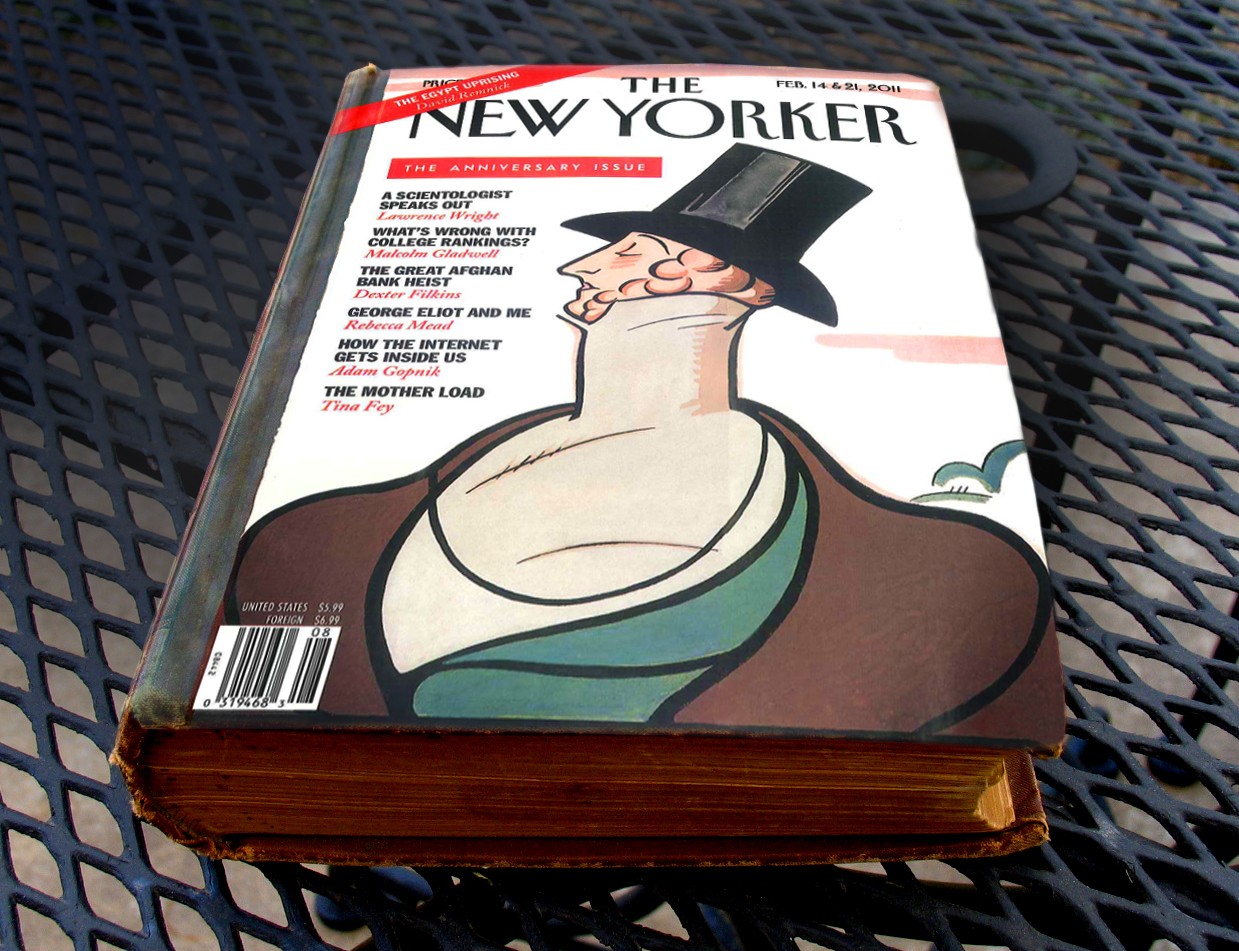
ATALE OF SUFFERING: UNDELIVERED NEW YORKERS.

For the last eight winters I have rented the Upper of a duplex in Santa Monica. For seven of those eight years I suffered the vagaries of forwarded mail. This past winter I decided to put in a change of address with The New Yorker. 

For the first two months things went well. The magazine appeared in my mailbox every Thursday. Then came an issue that was incorrectly collated. I got two first-halves instead of a first and a second half, thus missing out on the Cartoon Caption Contest The copy at the local library was similarly mis-collated. When I registered a complaint with The New Yorker, I was told that they had no extra copies and therefore could not replace my defective exemplar. It was cold comfort to me that they extended my subscription by one issue instead.
            
Toward the end of March, my landlady (who occupies the Lower) went on holidays and stopped delivery of her mail. Sometime after her departure, my husband remarked that we had not received any junk mail for several days. A packet we expected also failed to arrive. The tracing site said that an unsuccessful attempt had been made to deliver it, and a note to that effect had been left. But our mailbox yawned empty. Needless to say: No New Yorker.
            
It appeared that the post office had decided to stop delivery for both the Upper and the Lower duplex. My husband went to the local post office to make inquiries. He joined a long line-up of (similarly short-changed?) customers. When his turn came, a woman, who moved at a glacial pace, went off to look for the missing packet. She returned, stony-faced and unapologetic, with the item in question, but refused to look for mail that did not have a tracer number. Which included The New Yorker. Two New Yorkers by that time.
            
We left Santa Monica on 10 April and returned to Canada by car (a road trip of five days) by which time I had been without The New Yorker for three weeks.  A friend saw me suffering from withdrawal symptoms and retrieved one issue from her recycling bin, pulling me back from the brink.

In the meantime I had reversed my change of address, and The New Yorker once more appeared at my door – for one week. The next week: nothing, and no explanation. Delivered to the wrong street perhaps? Not likely because the people at the local post office here have moxie. A few days ago a friend sent me a book. She addressed it to “31 Morton”. Someone had written on the package: “Try 31 Manton”. They definitely know where to find me!

 I am happy to report that this week’s New Yorker has arrived and hope my luck will hold. I think I’ll tweet the good news: #amreading The New Yorker!

Thursday, 7 May 2015

ANTISEMITISM IN VIENNA 1885 -- NOT A JOKING MATTER.

In 1885, Paul Vasili (pseudonym for French feminist Juliette Adam?) published a book on Viennese society. One chapter deals with anti-Semitism, adopting a satirical tone.

The driving force behind anti-Semitism was the politician Georg Schönerer, modestly talented as a speaker, modestly talented as a lawmaker, modestly talented as a politician and economist,…but a man with a raging ambition.

One day he asked himself how he might obtain fame.
He searched and searched…and seized on the first idea he came across, the most extravagant idea anyone could raise in Austria: to make Austria German.

An evil omen of things to come, Schönerer visited all taverns, drank everywhere with students, insinuated himself into their company, held speeches, and everywhere spread the gospel of a union with Germany.

The idea did not appeal to Austrians at the time. His speeches prompted either general amusement or vehement protests…no one in parliament took this nonsense serious.

Then Schönerer was touched by a more beautiful inspiration…he declared himself the leader of Austrian anti-Semitism. The idea was to save the greatly endangered Christian-Germanic society from Judaism and to defend its material interests against the amoral influence of the Jews.

And so Schönerer began his campaign – a well-nourished man, solid, with a broad ruddy face, and a short, thick neck… a man more like a circus-Hercules than a prophet, but incomparable in his zeal, his fire, and his energy. He no longer sleeps, he no longer eats. He doesn’t go to bed any more. Night and day he moves around. Apparently he has given up on the idea of Anschluss -- joining the German-speaking provinces to the German Empire. He focuses all his enthusiasm on the destruction of Israel’s people. He roams the country, and brings the hunt of Moses’ sons to every town, every village, and every hamlet. – I am joking, but it’s not right to joke about it.

(Source: Paul Vasili, Die Wiener Gesellschaft, my trans.)

Sunday, 3 May 2015

BASQUIAT and FRIENDS. #amreading Jennifer Clement.

BASQUIAT
  • He was attracted to people who silently bore some sort of inner pain. 
  • His paintings are jazz on canvas.
  • He doesn’t read books. He looks for the words that attack him and puts them on canvas.
  • Looking at boxing gloves, he could feel thunderbolts in them.
  • He was a barometer for the racist culture he lived in. He felt everything around him in a heightened way. It was not only cocaine paranoia.

RAMMELLZEE
  • He walks in a bebop kind of slide.
  • He looks for his shadow and crawls up inside it.

ANDY WARHOL
  • Why does Andy need you, Suzanne asked Basquiat. I recharge his batteries, he said.
  • Basquiat loved Andy because he loved to feel the power he had over Andy.

SUZANNE MALLOUK, BASQUIAT'S "WIDOW"
  • Suzanne left home: Feel gray, must exit.
  • Life can be a circle, not just a line.
  • Afraid of testing positive for AIDS and promises God: If I’m negative, I’ll never do dope again. I’ll never sleep with strangers again…But she does not believe in God. And she breaks all her promises.
  • Suzanne at Basquiat’s funeral: I thought if I covered my mouth, the knowledge of Jean’s death could not get outside of me.

(Source: Jennifer Clement, Baquiat’s Widow)