Showing posts with label Fynes Moryson. Show all posts

Thursday, 4 September 2014


SOCIETY FOR THE PREVENTION OF CRUELY TO ANIMALS? NOT IN NAPLES, 1594

When Fynes Moryson arrived in Naples in 1594, it was the shape of the buildings that first attracted his attention: They are four stories high, but the tops lie almost flat, so as they walk upon them in the cool time of the night. The windows are all covered with paper or linen cloth; for glass windows are most rare in Italy, and as it were proper to Venice.

The streets were so narrow, they cannot use coaches. One fashion pleased me beyond measure, that at the end of many streets they have chairs, commonly called Seggioli di Napoli, which those that are weary do enter, and they being covered round about, and only having windows on the sides, he that is carried therein cannot be seen of any, and yet himself may see all that pass. Two porters carry these chairs by two long staves fastened thereunto, and lift them but little from the ground, and so for a moderate price carry the passenger to any part of the city.

Near the city, he visited the Cave of the Dog, so-called because dogs were used to test the poisonous air in the cave. They paid a woman for a dog fastened to a long staff, and so thrust him into the cave, holding him there, till he seemed dead, and being taken out, would not move for any blows we gave it. Then according to the fashion, we cast the dog into the lake, and when he was drawn out, he began by little and little to move, and at last being come to his senses, ran away as if he had been mad. A Frenchman was incautious enough to omit the dog test and ventured into the cave trying to fetch a stone and paid for his curiosity by unrecoverable death.

(From Fynes Moryson, An Itinerary; English modernized)

Thursday, 21 August 2014


SIGHTSEEING IN VENICE, 1594

 
Here is what a tourist would have seen in Venice, 1594:

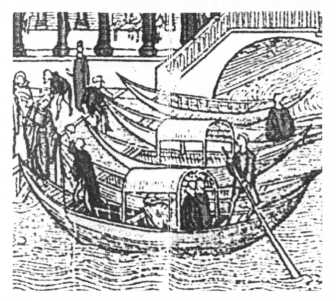
Gondolas:The boats are very neat and, except for the ends, covered with black cloth, so as the passengers may go unseen and unknown, and not be annoyed at all with the sun, wind, or rain. And these boats are ready at call any minute of the day or night.

Holy relics at St. Mark:  A piece of a bone of Philip the Apostle, a piece of the cheekbone and four teeth of the Martyr St. Biagius, pieces of bones of St. Bartholomew and St. Thomas of Canterbury…and part of the hair of the blessed Virgin, and a piece of a finger of the Evangelist Luke, and a piece of a rib of St. Peter …which shows how they worshiped images in a more modest though superstitious age.

The Ghetto: The Jews have a place to dwell in separately, called Il Ghetto, where each family has a little house and all have one court-yard in common, so that they live as it were in a college or alms-house and may not come forth after the gates are locked at night, and in the day they are bound to wear a yellow cap.

Palazzi: The palaces have one door towards the land, and another towards the water, and most of them have gardens. The floors of the upper rooms are not laid with boards, but plastered with lime tempered with tiles beaten to dust.  The windows are for the most part very large, lying almost altogether open to receive air, but the lodging chambers have glass windows whereof the Venetians brag, glass being rare in Italy, where the windows are for the most part covered in linen or paper.

This noble city is rightly called in Latin Venetia, as it were “Veni etiam”, come again!
(Source: Fynes Moryson, An Itinerary)

Sunday, 10 August 2014


NOT JEALOUS OF A NAKED TOUCH.  Having fun in a Swiss spa, 1592

More from Fynes Moryson’s Itinerary Containing His Ten Yeeres Travell:

[In Baden, three miles from Zurich] diverse baths are contained under one roof of a fair house, and without the gate are two public baths for the poor.

These waters are so strong of brimstone, that the very smoke warms those that come near, and the waters burn those that touch them…One is so hot it will scald off the hair of a hog.

Many visitors have no disease but that of love, even if they fain sickness of body. They come hither for remedy, and many times find it. Women come hither as richly attired as if they came to a marriage, for men, women, monks, and nuns all sit together in the same water, parted with boards, but so that they mutually speak and touch, and it is a rule here to shun all sadness, neither is any jealousy admitted for a naked touch. 

The waters are so clear that a penny may be seen in the bottom, and because melancholy must be avoided, they recreate themselves with many sports while they sit in the water, namely at cards, and with casting up and catching little stones, to which purpose they have a little table swimming upon the water, upon which sometimes they do likewise eat.

These baths are very good for women who are barren. They are also good for a cold brain and a stomach charged with rhume [stomach flu], but are hurtful for hot and dry complexions.
 
The town of Baden makes great profit of the spa, by the great concourse of sickly person.

(Spelling modernized)

Thursday, 7 August 2014


FROM GAZA TO JERUSALEM. TRAVELS IN 1596

 
More from Fynes Moryson’s Itinerary Containing His Ten Yeeres Travell:

 We coasted the land of the Philistines, and first did plainly see the City of Gaza. On Friday we entered the Haven of Joppa [Jaffa] and [entreated the ruler] to give us leave to pass to Jerusalem.

The shore of the Philistines seemed to be a wild, narrow and sandy plain near the sea with mountains pleasant and fruitful towards the East upon Palestine. The City of Joppa had some ruins of walls standing, but not so much as any ruins of houses. [We encountered only] the exactors of tribute come out of two ruinous towers, and some ragged Arabians and Turks lying within certain caves.

We thought it better to stay on our ship, especially since the place afforded no entertainment for strangers. Our mariners brought us eggs and fruit, and we had with us wine and biscuits, which we hid, lest the Arabians or Turks should take them from us.

On Monday, [the ruler sent us a guide] and an interpreter, a Maronite Christian. They brought us asses to ride upon. The asses had panels instead of saddles, ropes for bridles, and ropes laid across the panels and knotted at the ends instead of stirrups.

In the port of Joppa we had bought apricots, but we were afraid of eating too much of such dainties. The intemperate eating whereof, we had read, has often killed Europeans.

In Ramma we were brought into a house, where pilgrims used to be lodged…but at this time more fit to lodge beasts than men…The rooms were full of dust, and we hardly got straw to lie upon.

Someone in the name of the ruler brought us a present of some flagons of a medicinal drink made of cooling herbs and sold in the taverns, as we sell wine.

[We hired a watchman] to protect us from wrong, who being a man of very great stature, was called Goliath, and he walked all night and sang or rather howled with his hoarse voice continually.

[We rode toward Jerusalem at dawn] and were warned to be silent lest we waken the Arabians, Turks, or thieves…who were likely to offer us violence or at least to extort some money from us. The Arabians are not unlike the wild Irish…and cannot be brought to due obedience, much less to abstain from robberies.

We were within two miles of Jerusalem when a spachi (or horseman under the great Turk’s pay) riding swiftly and crossing our way, suddenly turned toward us and with his spear …rushed upon us…By the grace of God his spear lighted in the panel of an ass and never hurt the Frenchman, his rider.

[When the guide asked the reason for his violence, the horseman said]: Why don’t these dogs get down on foot and honour me as I pass? …We presently tumbled from our asses and bent our bodies to him. And we did not act basely in doing so, but wisely, for woe be to the Christian who resists any Turk!

(The English spelling has been modernized. Map by Sebastian Munster, 1598: http://www.antiquemaps.com/uk/mzoom/29756.jpg)

Sunday, 3 August 2014


SIGHTSEEING IN GERMANY, 1591.

Fynes Moryson, the son of a Lincolnshire gentleman, travelled in Europe to observe local customs and economic conditions. Here are some extracts from his Itinerary Containing His Ten Yeeres Travell, first published in 1617.

  • The citizens of Hamburg have a strong dislike for Englishmen. It is unsafe to walk out of the gates after noon, for when the common people are once warmed with drink, they are apt to do them injury.
  • The porters demand to be paid up front, for this is proper to the Germans that they will be paid ere they begin to work.
  • In Wittenberg Moryson was shown the house in which Luther gently died….but this is not the place where he died, neither was there any bed…They tell many things of Luther which seem fabulous. Among other things they show an aspersion of ink cast by the devil when he tempted Luther.
  • Moryson was not impressed with Wittenberg, a city, where there is nothing but whores, students, and swine.
  • In Dresden he read a Latin inscription of which he approved: Aut nulla ebrietas, aut tanta sit ut tibi curas demat, which he twists a little in his translation: Be not drunken, or no more than may cares assuage.  In my opinion it means: Either don’t get drunk or get so drunk that it takes away your sorrows.
Any Latinists out there want to referee this?