Thursday, 27 July 2017
Sunday, 16 July 2017
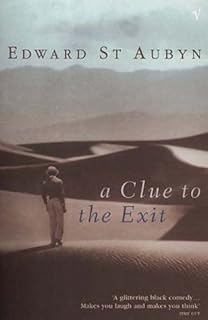
#AMREADING EDWARD ST.
AUBYN’S A CLUE TO THE EXIT.
Charlie
has been given six months to live. What’s the best way to use those last
months? Spend all your money? Have torrid sex? Find your authentic self? All of
the above, and if you are a bestselling author, shock your agent by writing a
serious novel.
First then, find your authentic self, but that's not easy when it is buried under your surrogate self, the carrier of some cherished quality, the vehicle for a
certain story that needs to be shaped.
Another problem: friends who will not leave you in peace, friends with a psyche like a wildcat prospector, producing eruptions of
unwelcome insight.
But
at least Charlie succeeds in finding love/sex with Angelique who also helps him to get rid of his
money, gambling on his behalf, while he watches the gamblers drifting past like fish in an aquarium.
Yet
he cannot find peace and is plagued by thoughts
like a cloud of gnats at sunset, made visible by the dying light. In the
end, however, his torment is replaced by
the congealing powers of resignation and habit.
Meanwhile
the characters in his novel take shape: a woman loyal to her husband who is in a coma (are those feelings akin to necrophilia?). The woman and two fellow philosophers discuss the
nature of consciousness while stuck in a train stopped at Didcot. What else was there in the end? A man’s
biography was the history of what he had given his attention to, and so it
seemed worth knowing what attention was, and how it related to other types of
knowledge.
Angelique spends all of Charlie's money and departs. He muses whether it would be better not to wait out the six months and to commit suicide instead. It was less upsetting than this limitless
white terror, bleaching every object in its universe …It’s always the same
story: if you want something done properly, you have to do it yourself.
Tuesday, 4 July 2017
Friday, 23 June 2017
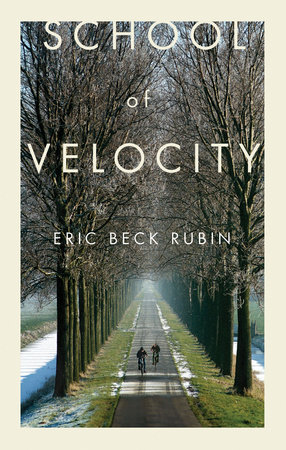
#AMREADING: ERIC BECK
RUBIN’S SCHOOL OF VELOCITY.
Jan’s
career as concert pianist is ruined by auditory hallucinations, a needling high-pitched ringing, a cascade
of notes, raining down like hammers from the ceiling of the concert hall. Are
they a flood of memories, of words left unspoken between him and his charismatic
childhood friend Dirk.
He was like a new
word that, once learned, you heard spoken everywhere. Compelling attention.
Mine, yours, anyone’s. Dirk is a consummate actor, but when they two
friends are alone, he reverts to his self. The
hunch returned. The loping strides. The fiddling with his ear. The sly smile.
This
is a novel about music and about a friendship that could be love.
The
music: Notes balanced on the thinnest,
most fragile wire, ascend and descend. Underneath it all a regular pulse of octaves in the bass clef
gives the piece a steady and abiding feeling of hope. And then there is
Rachmaninoff: A tumbling that builds up
to an explosion of chords, broken and solid, shooting up and sliding down
octaves. The tempo increases until runs of notes crash in waves running
crosswise. Dirk would like the Rachmaninoff.
The
friendship: You and Dirk. I might’ve
guessed you two would fall out of touch completely, but it could’ve been the
opposite. Pirm smiled and shook his head slowly. You know, Jan, we all thought
you two were… He grinned. Us two what? I
said.
There
was only one way for Jan to find an answer to that question. To look up his old friend.
A thunderclap runs from
ear to ear, like weather starting up again. My arms start to shake. I don’t
have much time. I begin to blurt out the words. What I’d meant to say from the
moment I stepped in the front door.
Friday, 26 May 2017
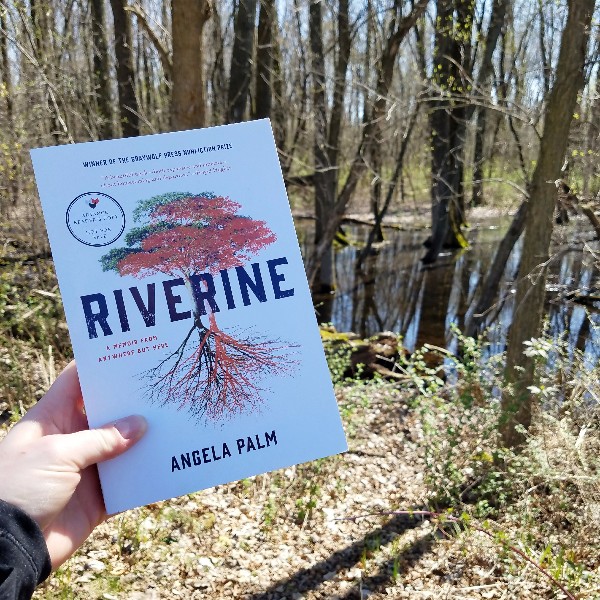
#AMREADING: ANGELA PALM’S MEMOIR RIVERINE.
Angela
Palm’s memoir reads like a novel. You keep waiting for a plot to develop, for
something to happen to the heroine that will create the familiar story arc, but
all that’s happening are thoughts and observations in beautiful language.
Childhood
Angela consults a map and finds that she lives in
between two red dots indicating towns, like
some half-breed spawn of both worlds and alien to both.
Neither
town wants her. She is stunned by this new perspective. Everything I saw was familiar – driveways and houses I’d seen before.
These were signs of home, but I felt spat out like bad milk.
Because
her house is so far from town, solitary
pursuits replaced social ones, and a cacophony of ideas swirled in me.
There was, from a
young age, already a disconnect between the way I processed experiences and the
way others conducted themselves, the way I was critical of my surroundings and
the way others seemed to float through them without taking note of anything.
Teenage
years
We knew the land as
we knew our teenaged bodies. Ripe, firm. Yielding in places. In those days,
running was nothing but an extension of self. Like breathing. There was no
labor in it, only direction and the feeling of blood rushing in our veins.
She
falls in love – if love was a pull,
magnetic and inevitable as gravity. If it was a secret, best kept slow and
steady and unspoken.
Returning
home after twenty years
I wondered which part
is most real – the conscious or the unconscious. Whether the place itself is
the thing that stays, or its effects on a person. One is concrete and one is
embedded in the brain, in memory.
Image: www.sophisticateddorkiness.com
Subscribe to:
Posts (Atom)