Wednesday, 30 April 2014


CONSPICUOUS CONSUMPTION? BRING BACK SUMPTUARY LAWS
A Senate decree passed in Venice 1515 noted:

·         There is such gross and unnecessary expenditure on meals and banquets, on the adornment of women, and on the decoration of houses, that fortunes are squandered and a bad example is set to those who seek to live modestly.
·         To correct that trend, the Venetians passed laws to limit conspicuous consumption. at WEDDING BANQUETS, for example, no more than three kinds of meat could be served. Wild birds and animals, Indian cocks and hens, and doves are strictly forbidden. Oysters may be served only at private meals for up to twenty persons.
·         To control personal adornment, women wanting to wear pearls must register them, declaring the number, weight and quality.
·         In Florence anyone wanting to wear gold, silver, pearls, precious stones..or cloth of silk brocade had to pay an annual tax. Married women could wear two rings tax-free.
·        The rationale of sumptuary legislation in Florence: to restrain the barbarous and irrepressible bestiality of women who force men to spend money on them. On account of these unbearable expenses, men are avoiding matrimony. 

I think we need laws like that men aren’t force into unbearable expenses and avoid dates, or maybe just to put brakes on NICK PATERAS, whose second date went like this.

·         He needed something to make the blood rush to his heart. No, not falling in love. Something more exciting. So he and date drove to the airport, where they sprinted from desk to desk to find a flight to -- somewhere. They ended up spending the weekend in Port of Spain.
·         When they got back, they looked at each other in awe. Right. Isn’t conspicuous consumption an awesome thing?
·         Now www.blog.westjet.com invites your comments. I suggest sentencing the couple to 40 hours of community service, but I doubt that’s what West Jet has in mind.
(Info on Renaissance sumptuary laws comes from The Society of Renaissance Florence and Venice: A Documentary History.)

Sunday, 27 April 2014


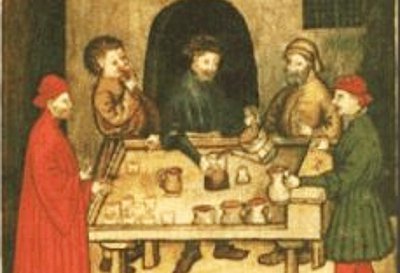
RACIAL PROFILING, 1509: The Jewish pawnbroker.

From a nasty diatribe against the Jews by the convert Johann Pfefferkorn:
When someone comes to a Jew with an article to be pawned, the Jew knows that that person is under duress.

  • The Christian shows him a ring, expecting a certain amount of money for it. The Jew inspects it all round and replies: No, I cannot lend you that much. The Christian is in desperate need for money and says: How much then will you lend me? Then the Jew turns the pawn back and forth, inspecting it closely and, after a long examination, says: A ring, of all things! And he names a small sum he is willing to lend on it, say, one gulden.
  • The Christian takes the gulden in the hope that he will soon be able to redeem his pawn, but he becomes poorer by the day, and when one year is over and the Christian does not redeem his pawn, which is worth much more than the loan, it has passed by default to the Jew for the small sum he lent for it.
  •  If the Christian comes before the year is over to settle his account, interest has accrued on it and his debt now amounts to 1 gulden, 34 pence, and 8 hellers. The Christian cannot pay and begs the Jew to let the interest accrue together with the initial loan at the usual rate. Then the Jew replies: With pleasure, but you need to bring me more collateral. And that is what the Christian does. 
  • The second year, the original loan plus the interest amounts to 2 gulden and 46 pence and 4 hellers. The Christian cannot pay it and begs the Jews, as before, to let the interest accrue. But if he cannot bring him more collateral, the Jew takes the pawn into the city and publicly offers it for sale. Thus the Christian is embarrassed before a number of people, and so he brings everything he has in his house and privately hands it over to the Jew. Now that the Jew has for one gulden goods valued at a hundred gulden or more, the poor Christian has nothing left to pawn and runs away and must live in poverty for the rest of his life. This happens a great deal and often.
(Image from The Calculation of Ruprecht Kolperger, 1491)

Thursday, 24 April 2014


HAVING FUN IN RESIDENCE. Alcala, 1510.

More from the regulations of Idelfonso College.

  • When leaving the residence and going into town, members are to wear the regulation-issue hooded cloak.
  • No resident shall grow a beard or long hair. Rather, they should resemble respectable secular priests in their appearance.
  • None is permitted to go into a tavern and have a meal in town, unless by permission of the rector.
  • Let no one presume to bear arms either openly or concealed, or have arms in his room on penalty of being deprived of his meals for a month and having the weapon confiscated.
  • No one is allowed to play dice or cards.
  • We strictly forbid the playing of any kind of musical instrument in College, except the monochord and the cembalo.
  • On feast days college member are allowed to play ball and engage in other physical exercises, provided these activities are carried on in the inner courtyard, where they cannot be observed from the outside. And let the rector not grant such permission lightly, but only when he sees that the work must be lightened with these kinds of respectable pastimes.
  • We furthermore forbid that any women be given access to the College at any time, except by permission of the rector. He will appoint a person of integrity to accompany the visitor and show her the buildings of the College. Just the buildings, I take it. The men, I hope, were hidden away so as not to corrupt her chaste eyes.
       (Image from www.junkyardsports.com)

Monday, 21 April 2014


DINING IN RESIDENCE, Alcala 1510.

From the rules of Ildefonso College:
  • No one is to be served food outside the dining hall.
  • Members of the college will drink from silver cups (donated to Ildefonso by the founder), so that beverages may be served in a becoming fashion.
  • Each person will also be supplied with a knife, a saltshaker, and a jar of water.
  • Each person will eat the same quantity of food, prepared in the same manner.
  • During lunch and dinner spiritual reading shall not be neglected. Ordinarily the Bible shall be read at lunch. At dinner, other books of saints or doctors may be read, as long as they are approved by the church.
  • If the reader mispronounces words or mumbles, he shall be corrected by a senior lecturer in theology. If no theologian is present, a professor in the faculty of Arts will do the correcting.
  • Let everyone listen attentively to the reader and beware of seditious and scandalous talk, on threat of a harsh penalty proportionate to the seriousness of the offense and the status of the person.
  • Only those whose business it is to prepare and season food are allowed to enter the kitchen or the cellar. Any resident found on the premises will be deprived of his portion of wine for the day.

Wednesday, 16 April 2014


A DESCRIPTION OF PASSOVER RITES, 1509.

Cover image of Pfefferkorn's book
This description comes from a booklet entitled How the Blind Jews celebrate their Easter (Wie die blinden Juden yr Ostern halten). The author, Johann Pfefferkorn, was a German Jew who converted to Christianity.  The book clearly shows his anti-Semitic bias, but provided German readers with an early (the first?) account of Jewish religious practices.  

  • The flour to be used in the holy meal must be ground with a clean and newly-hewn grindstone and kept in freshly-washed bags. … The houses of the Jews are very smelly and unclean, but at the time of this feast they are quite determined to cleanse all rooms in their houses and to sweep them clean, also to scour clean their utensils, especially pots and bowls, and anything else used in the preparation of food, although they do not use them at this time. Rather, they have dishes specially kept from year to year for this feast. They also polish to a sheen all the silver and pewter dishes…Then they bring them to the rabbi for inspection, whether they are clean and right for use in this feast.
  • On the second day before Easter, after sundown, the head of the household himself goes with a lit candle from room to room and zealously searches the whole house, and if he finds anything unclean, he collects it and burns it to ashes.
  • On the day before Easter, after sundown, they make dough [of clean flour and water fetched from a stream], but without salt or yeast… The head of the household himself takes the dough and with his own hands fashions three cakes.
  • When the cake has been eaten in the proper manner, each person takes up his prayer book. Then, on the command of the father of the family, the door is opened and someone riding a donkey, which has been ordered for this purpose, comes into the room. All who sit there loudly recite the words of the [79th] psalm, like this: “O Lord pour out your wrath over the nations that do not acknowledge you” – meaning us Christians.
  • Around midnight they go to bed and that night act very unchastely, for each of them hopes that the Messiah will be born of him.
 (For Pfefferkorn's anti-Semitic campaign and the resulting controversy with Reuchlin, see my book: The Case against Johann Reuchlin. Religious and Social Controversy in Sixteenth-Century Germany)